


The Swollen Bursa in your shoulder needs rest to heal. You may be offered "shortcut treatments" that only mask the pain temporarily. To truly heal you need to skip the gimmicks and focus on healing the underlying injury.

Your Bursa is a sac full of Synovial Fluid, and your body is making the fluid to help heal an injury.
That is your own body's medicine that it is making to heal another injury inside your shoulder.
Shoulder Bursitis is typically caused by an injury in the shoulder that leading to inflammation in the surrounding tissues.
The body is making more synovial fluid to help heal the injury and draining it will interrupt the healing process.
You don't want to drain it, and if you do, your body will keep making more as long as the other injury remains.
Seek proper treatments for the underlying injury and use an ice compression wrap in 20 minute intervals throughout the day, to try to move this valuable fluid back where it is needed.

There are a million companies selling bands and compression wraps for you to wear all the time. Companies like Amazon sell them because they can, not because they help. What does Amazon know about treating injuries? Nothing. If they can sell it, they sell it, and that's it.
Most shoulder compression sleeves are designed to squeeze the shoulder too tightly.
Worse they don't use cold.
The end result is increased irritation of the Shoulder Bursa.
This leads to more swelling and pain.
Yes, mild cold compression can help gently squeeze swelling out of the area, reducing pain, but you should do this while at rest.
And only do it for 15 to 30 minutes at a time.
Definitely not all day long, and definitely not when you are active.
If you want support for your injury, tape it.

This is often the first thing doctors will offer you for Shoulder Bursitis. Cortisone injections are designed to temporarily relieve pain and swelling, however, they come with a variety of risks and side effects. These include skin discoloration, allergic reaction, infection, and nerve damage. They're also associated with tendon rupture.
Cortisone shots are not designed to heal the injury.
They simply mask the pain and can cause you to feel a false sense of ability, leading to a higher likelihood of re-injury.
If the cortisone shot is not administered properly, there's a chance that it won't have any effect.
Some people are also unable to metabolize cortisone, meaning it would not provide them with any relief.
Cortisone contributes to the thinning of tissue and an increase in the likelihood of a tendon rupture in your shoulder as a result!
Please visit our Cortisone Shots page for more information on the potential dangers of cortisone.

Surgery is not truly required to heal most soft tissue injuries. Often with Shoulder Bursitis there are multiple injuries in the shoulder.
A lot of the time, Shoulder Bursitis is due to a small muscle tear or tendon strain, that will heal on its own with proper rest.
Surgeons offering "Shoulder Bursitis Surgery" actually just go in and remove parts of the bursa.
Other times they do a full bursectomy which removes the protection that bursa once provided.
This can lead to future complications.
Sometimes they repair other injuries in the shoulder, like a muscle tear or a bone spur, and still remove the bursa.
The bursa is there for a reason.
You need to heal it, not remove it.
A bursectomy will result in less pain, but also less protection between your shoulder bones and tendons, which will ultimately lead to worse problems down the road.
Shoulder surgery should be avoided as much as possible and if you do go this route, pick your surgeon very carefully.
There are many risks and complications associated with surgery, including nerve damage, infection, tendon rupture, and more.
There is also no guarantee that it will get rid of the problem for good.
If you do undergo surgery, you can still use our BFST® and ColdCure® products beforehand to help prepare your body, and after the procedure to accelerate your recovery. Always get a second opinion before signing up for shoulder surgery.
For more in-depth information about how an injury heals click here for our Healing Page.

A TENS machine does not stimulate blood flow. TENS is an acronym that means Transcutaneous Electrical Nerve Stimulation. What a TENS machine is designed to do, is overstimulate the nerves to relieve pain - it deadens the nerves. While you want to reduce pain from your injury, using a TENS machine over an injury is highly not recommended. Having your muscles pulse and flex uncontrolled will cause further tissue damage and slow down healing.
It is an important part of injury recovery, to feel the pain, and respect the pain. Pain is going to tell you when you're potentially causing further damage. Never mask the pain heading into any activity.

The purpose of physiotherapy is to help with strengthening the muscles surrounding your injury once the healing process is underway. Starting physiotherapy before your injury has had a chance to start healing and stabilize, will only cause further damage and more pain.
After being inactive for an extended period of time, you get muscle atrophy (weakened muscles). As your injury heals, physiotherapy can be an excellent resource to help you rebuild that lost muscle.
Just remember, your physiotherapist cannot feel what you feel. If you feel pain during physio or afterwards advocate for yourself. Physio should not hurt. You need to work within your pain limits. If an exercise hurts, you need to stop that exercise because you're not ready yet. As you heal you will be able to do more, but do not push yourself because this will only cause re-injury. This is true throughout your entire shoulder recovery. Always respect the pain.

Rest is very important when recovering from an injury.
Of course, too much rest can cause weak and stiff muscles, but resting when you can will help you avoid further injury.
While it is true that moving promotes blood flow, and in turn blood flow promotes healing, too much movement too soon in the healing process is a bad thing, as it only results in re-injury and a much longer recovery time.
Certain exercises and stretches may be beneficial to rebuild your muscles after you address the underlying injury.
But these should not be done until you are further along in the healing process.
If you are doing them too early you will know because your bursa will start to grow again.
You need to accept that for a short while, reducing your activity is important to letting your shoulder get over the hump in terms of healing.
You cannot keep doing the same level of activity you were doing before becoming injured.
You need to let your shoulder rest.
If you are driving through the pain, you are just making your situation worse.
This can't be stressed enough about shoulder injuries because your initial injury has turned into an overuse injury.
Rest is critical. Give your shoulder a break.
You can gradually work your way back up to your regular activities, but this will take some time.
You may want to consider activity modification.
This means trading in high impact activities like running for low impact activities like swimming.

Painkillers should never be used during times of physical activity. This is because painkillers completely block the pain signal, making you totally unaware that you're doing more damage to the injured area. Painkillers mask the pain, tricking you into thinking you're better and able to push yourself physically, when this will only result in further injury. Make sure you restrict painkillers to times when your body is at rest. An ideal time to take painkillers is before bed. Using painkillers when you're active means risking complete rupture of your tissue, and this means surgery and an even longer recovery.
While painkillers are effective at relieving pain and inflammation, they are not designed to address the root cause. In situations where the underlying injury is osteoarthritis or tendonitis, some meds can help if used at the right times. For more information about which meds help and when, give us a call, our treatment advisors will give you some excellent free advice. You need more than painkillers, though, if you really want to heal.

While using a heating pad on an injury can feel good due to the warmth, they do not provide any healing benefits. Many sites online are marketing heating pads in place of proper treatments like BFST®. The reality is that BFST® can heal soft tissue injuries, and heating pads can't. BFST® stimulates healthy blood flow in the area of your injury, deep below the skin. This increase in blood flow works to speed up the healing process. Heating pads can't do this. Heating pads simply bring blood to the surface of your skin, making it hot to the touch.
Unfortunately, many people buying inexpensive Chinese heating pads from American companies, like you see all over the internet, end up getting burned, not healed. There are thousands of complaints filed with FDA every year from people who get skin burns or burnt furniture and house fires from defective heating pads that were sold as solutions to their injuries. And unfortunately, those only represent a small portion of the people actually getting hurt.
In the first 6 months of 2023, the FDA received almost 300 reports of injury and fires, just as a result of heating pads sold for healing people. These were company names you may know, like Sunbeam, Conair, Mighty Bliss, Walgreens, Softheat, CVS, Healthsmart, Dunlap, Yeamon, and Drive. Many of these were sold through Amazon. ALL of them were sold as heating pads to help people heal. If 300 people actually reported to FDA, then you can expect that thousands who didn't report were also injured.
Get BFST® for healing. BFST® technology far surpasses the heating pad in terms of therapeutic benefits. BFST wraps are 100% safe and heavily vetted by over 300,000 users and several regulatory bodies including FDA.

Yes, topical creams can help relieve arthritis pain.
This is not because they heal arthritis, but because they just numb your nerves in the area so you don't feel it as much.
If someone is recommending topical creams to treat your Shoulder Bursitis, then someone is more interested in making money than really helping you.
With Shoulder Bursitis, you don't want to numb your nerves.
You may not enjoy the pain, but pain is your best guidance on what not to do.
If you need pain relief in the moment, use cold compression.
It works incredibly well.
But using a numbing cream means turning off your body's defense against reinjury, for hours at a time, and that's just a bad idea.
Getting past Shoulder Bursitis is hard enough, because it's so vulnerable to reinjury.
Yes, deal with pain in the moment with cold compression.
Don't turn off your body's defenses with pain numbing creams.

One of the biggest mistakes you can make during recovery is stopping treatment before your injury has finished healing.
The healing process does not end once the pain stops.
The healing process takes much longer than most people realize.
Many times, the pain will stop within a few days to a few weeks.
But it can take 6 weeks up to a few months for the tissues deep inside the body to be done healing.
Don't get ahead of the healing with your activities.
This is the fastest way to end up right back where you started.
You can click here for the full story on how injuries heal.
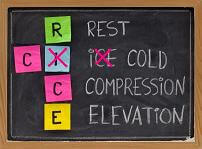
Most people think that RICE - Rest, Ice, Compression & Elevation - is the formula to follow when treating inflammation, swelling and pain.
The truth is that ice can actually freeze your skin and numb your nerves, causing 'cold burns' and even permanent damage to your underlying tissue.
Rest is absolutely a good thing.
The proper solution is RCCE® - Rest, Cold, Compression & Elevation.
For shoulder bursitis and fluid on the shoulder, the compression should be gentle and constant for 20 to 30 minutes at a time.
And for bursitis, unlike most ailments, elevation isn't going to drain the bursa.
It might though give a little relief for what the underlying injury may be, but generally it is a minor help for many shoulder injuries.
Where ice is concerned, we don't want to apply ice - we want to apply cold that is just around freezing.
Yes, you want cold - and lots of it - but not so cold that it is below the freezing point of water.
ColdCure® technology was developed specifically to address the need for a cold compression device that does not freeze the skin and underlying tissue.
ColdCure® gel packs pose no threat of cold burns.
This makes them much safer to use than other products that use ice, which can cause the skin to freeze, leading to permanent damage.
ColdCure gel packs are completely safe to use for extended treatment durations, meaning faster relief of pain and swelling.
ColdCure® technology is a huge improvement on regular ice packs.

Perhaps you noticed your shoulder pain for the first time when you were being active.
You can easily mistakenly think that activity is the reason for the pain.
But the reality is that most people who experience this condition have an injury that is the result of a sudden and traumatic activity.
It could be a fall or something hitting the shoulder.
The injury can be directly to the bursa or another part of the shoulder.
Often bursitis goes hand and hand with some other injury.
Perhaps repetitive activity is preventing the healing, but it is unlikely to be why you are injured in the first place.
If you have Shoulder Bursitis, stop repetitive activity until the pain is gone.
But once the pain is gone, you can go back to normal life... slowly.
If your injury isn't getting better, and you don't do repetitive activity, the issue might actually be isometric strain.
Isometric strain is a fancy term that means you held your shoulder under pressure for a long time in one position without moving it.
That leads to a cumulative strain situation and when you make the next significant motion, your shoulder can easily get injured further, setting back your healing.
That's the exact opposite of repetitive motion!
The pressure of the constant strain often damages shoulders but you don't realize it when it's happening.
That's a significant cause of Shoulder Bursitis.
Check out our Causes of Shoulder Bursitis page for the full story.
For a little while - not forever - it is really helpful to give your shoulder a rest. In many cases, resting your shoulder for a few weeks will give it time to heal to a point that your body gets ahead of the healing / reinjury cycle. It's important to realize that once the fluid, swelling and pain go away, your underlying injury may not be healed completely so take it easy and go back to regular life gradually once the pain and swelling are gone. If you want to be more proactive about healing the problem, you can click here to visit the Recommended Treatments page.

If you want your Shoulder Bursitis to go away as quickly as possible, you need to rest the affected shoulder.
Avoid any physical activities that could cause further injury to your shoulder.
If the fluid on your shoulder developed from a shoulder injury or condition, do your best to avoid the activity that caused this shoulder injury or condition.
Consider using a sling to remind you not to use your shoulder.
Not sure what caused your bursitis? click here to lean all about Shoulder Bursitis and potential causes..
Do regular Cold Compression treatments to control the pain and swelling in the back of your shoulder.
The compression during each treatment helps gently move the synovial fluid back into your shoulder from the bursa sac.
Use tape to protect your shoulder when you have to work or do other activities.
There is a reason you see athletes using tape all the time.
It works.
You need to be taped up the whole day if you are working, and most brands use toxic chemicals in the glue, so only use high quality medical support tape.
If you want to speed up healing as much as possible try a diathermic process like ultrasound or BFST.
You can use BFST at home to dramatically speed up the healing process by promoting blood flow to the injured tissues.
You don't need to use it, and you can heal fine without it.
But athletes, and those who have no time to waste, use BFST to heal, and get back daily activities as fast as possible.
Do a Cold Compression treatment if you experience any flare-ups of pain and swelling and after any significant activity.
Around the 6-8 week mark you can start doing some light stretching and strengthening exercises.
But only if you can do them with no pain.
Slowly work your way back to your regular level of activity.
Painkillers mask the pain, causing you to continue to stress and injure your shoulder. This will only make your condition worse. It is understandable that people need relief from the pain, so if you have to take painkillers, restrict them to times when you are off your feet. You can use painkillers to help you sleep. Using them when you are active is a recipe for permanent damage. Your choice of pain killers is important. You can give us a call to discuss which ones are best.
Shoulder Bursitis can be extremely painful and debilitating.
Painkillers such as ASA or acetaminophen are often used to treat the pain but these drugs do nothing to treat the actual condition.
In fact, most painkillers are known blood thinners that can have other side effects.
Cortisone injections are used in extreme cases but these too are intended to address the pain.
They do not promote healing of the injury itself and they put you at a very high risk of further injury.
If you want to be more proactive about healing the problem, you can click here to visit the Recommended Treatments page.

