


Side View Rotator Cuff

Healthy Rotator Cuff

Muscles of the Shoulder

Injured Rotator Cuff

Shoulder Injury

Injured Shoulder Posterior

Frozen Shoulder

BFST Shoulder Wrap

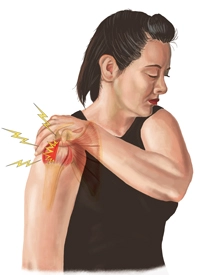
Many people want the "quick fix", but is it the best choice?
One of the first things to consider is whether it is a partial tear or a complete tear.
A full or complete tear means that a muscle or tendon is completely torn in two.
While a partial tear could be large or small but it is still connected even if it is hanging on by a thread.
Most partial tears have a good chance of healing on their own without surgical intervention.

If it is a full tear then it will take surgery to repair it.
Timing is very important.
If the tissue is torn all the way through with no connecting fibers then the two sides will begin to pull away from each other.
After a period of time the two sides of the tear may no longer be close enough to each other making it impossible for a surgeon to connect them back together.
This tear isn't sitting open on the surface below the skin where the surgeon can make an incision and clearly see the two ends.
The area of the tear is between various layers of muscle, ligament, tendon, and other tissue.
If the ends pull far enough apart it's not really possible for the surgeon to weave it back between the other tissue.
But if it's a recent full tear, then there is a chance that a good surgeon can repair it.
Again, this sense of urgency only really applies to a full tear.
If you have a partial tear then you probably don't need surgery.
There are way too many unnecessary Rotator Cuff surgeries done each year.
You will likely be offered the option.
Many times, surgeons are enthusiastic about doing a surgery.
But that does not mean you really need the surgery.
The enthusiasm and confidence of a surgeon is often all it takes to propel someone who does not need surgery into getting it.
Make sure you ask good questions, get a second or third opinion, and weigh your options.
Ask what happens if you do not do the surgery?
Is it a partial tear or complete tear?
Will the tear heal on its own?
If so, what benefit is the surgery in this case?
One important note on a partial tear. If you have a large partial tear with just a little bit of fibers holding the tear together then there is risk of it tearing the rest of the way. In this case it might make sense to move ahead with surgery before it becomes a complete tear. But if the tear is stable there is also a good chance that it can pull itself together and heal on its own.
The Rotator Cuff is a group of muscles and tendons in the shoulder that enable you to lift and reach with your arm.
The shoulder joint has the largest range of motion of any joint in the body.
Because of this range of motion, the shoulder is put under stresses that other joints are not.
It is also often placed under continual and repeat stress.
Sometimes these stresses occur while the shoulder is at the end of its range of motion where it is most vulnerable to injury.
For these reasons the muscles of the rotator cuff can become strained or torn.
Most strains and tears, even bad ones, can heal on their own.
Typically, only a full tear, sometimes called a "complete tear" or "full thickness tear" require surgery.
When you research Rotator Cuff Surgery online you will find a ton of sites telling you the same unhelpful message.
They correctly identify it's made up of these muscles: Supraspinatus, the Infraspinatus, the Teres Minor, and the Subscapularis.
But this will not help you understand your injury.

This is a part of your body where a thousand strands of tissue narrow down to 100 stands.
This narrow point is vulnerable to injury when placed under great stress.
A Torn Rotator Cuff is almost never in the wider mass of muscle.
A rotator cuff tear happens at the top of your arm, across the top or outside of your shoulder, really close to where the tissue attaches to the bone.
You know where the damage is.
You can feel it!
The internet may also tell you that Rotator Cuff Tears are because of degeneration.
That's a fancy way of saying the tendons at the joint are worn out.
Yes, age and degenerative damage can contribute a small amount to conditions that make it possible to damage the Rotator Cuff.
But a rotator tear most often happens because of a fall, a sudden and heavy strain, or other sudden incident.
And regardless of your age or prior level of activity, if you treat your shoulder correctly, it will heal completely.
If you slip and catch yourself, you place and extreme amount of stress right at the point in your shoulder where all those muscles narrow down to a small connection.
This type of sudden, huge stress on this tiny point is usually the cause of the damage.
This damage will be in the form of an overstretch or a tear that can heal with proper care.
Most of the time the injury is a small tear in the muscle and tendon that can heal on it's own without surgery.
You have several options for this type of surgery and your doctor will make a recommendation for which one they think is best. You can do open repair, mini open repair, or Arthroscopic. Regardless of which one you do; the goal is to stitch the two sides of the tear together so your body can take it from there and pull the sides together to heal.

An open repair means the surgeon will be making a larger incision so they have more access to the surrounding area as they work. This may be more common with full tears where the torn end is pulling farther away from the connection point to the shoulder. In this case, the surgeon is going to have to try to cut a bit more, and do more work, to pull the torn tendons back to the connection point. Another example might be if the tear is large or complex. Or if there are multiple tears. An open repair is a bigger deal. It means cutting through more surface tissue, just to get to the injury.

A "mini open" just means they are going to make a smaller incision. Think of this as an intermediate grade procedure. A mini open repair means that your surgeon may need to 'dig' to get the severed tendon end, but they think they know a clean and direct route. Often with a mini open repair the damage affects a smaller, contained amount of tendon. Your injury affects a smaller amount of tissue so the incision and procedure gets to be 'smaller'. But it will still be larger than an arthroscopic incision.
Arthroscopic means they will insert a camera and tools through one or more very small incisions.
Generally speaking, the smaller the incision the shorter the healing time and less risk of infection or other complication.
This will be common with serious partial tears where the tendon is still hanging on and not fully severed.

Given the different situations describe above, the open surgeries are an older way of doing Rotator Cuff repair and Arthroscopic repair is newer.
Over time, surgeons are moving to doing more repairs with the less invasive techniques than they did in the past.
That doesn't mean smaller is always an option, but it's moving that way.
Your surgeon may want to do an open repair if there are issues that would make it harder to fix with arthriscopic surgery.
It also might come down to your surgeon's comfort level with a specific procedure.
All of these surgery types have been done for many years and the results are well understood.
The skill and experience of your surgeon is very important.
Some older surgeons may use older techniques.
But they may have a lot of experience and be very good at it.
Newer doctors use newer techniques but do they have the experience?
Lots of experience with the newer technique is generally the best option.
Ask your doctor straight up, "how many times have you performed this procedure?"
"Hundreds" is what you want to hear.
Hundreds with the newest technique might be better than hundreds with the oldest method.
Ask them if they will be doing the surgery themselves or if they will just be attending.
Sometimes surgeons work with a resident or someone less experienced who might actually do the surgery under their watch.
Do you want the expert or the student performing your operation?
Take the expert.
Let the less experienced doctor watch the expert this time.
Make sure this point is clear.
While new doctors need to get experience somewhere, you don't need to be that patient.
Let someone else be the guinea pig.
It's important to ask lots of questions.
Ask if they will do it arthroscopically or as an open surgery and why.
How many of these surgeries have they done?
What do they expect the results to be?
Will you regain full use of your shoulder?
How long will it take to recover?
What is the risk of reinjury during the healing process?
Can you heal without the surgery?
If they say you can heal without it then ask why they suggest doing it in this case.
Sometimes a surgery is really needed in order to heal.
Just take the time to ask lots of questions.
Get multiple opinions.
Then make the decision you feel is right for you.
Most Rotator Cuff surgeries are successful and you can go home the same day.
When you have Rotator Cuff Repair surgery you are putting a lot of stress on the arm.
You will need to limit what you can do with that arm while you are healing.
In order to get to the tear in your shoulder, a surgeon will need to make incisions in other tissues.
They may need to cut straight through another muscle and create an opening to work through.
So, now you have several places that need to heal.
Until this healing has happened you have made the shoulder less stable.
Not more stable.
After surgery your Rotator Cuff is very vulnerable to reinjury.
One wrong move can undo all of the work.
So, take it very slow.
Stitches are not strong like healed tissue.
They are temporary artificial bonds just there to hold the tissues together while the real bonds are made by your body.
It's normal to need pain medication for dealing with pain after surgery.
But you want to stop using them as soon as you can.
When you do use them, they are best used at night to help you sleep.
During the day it's important to not mask the pain.
Masking the pain makes it more likely that you will reinjure yourself.
And after all you've been through, you don't want to undo the repair.
Pain is your body's signal that reminds you not to do things that can cause injury.
Yes, it's fair to want to get rid of the constant pain from the surgery trauma and the incision and stitches.
No, you do not want to hide the pain that tells you when you are moving the wrong way and undoing the benefits of surgery.
Be careful about masking this important message your body is giving you.
The success of your surgery depends on you taking care of yourself post-op.
As part of your body's natural healing process, the newly sewn tear tissue will naturally pull itself together and become very strong over time.
But after surgery this process has not happened yet.
The stitches are just holding the two sides of the tear together to give them a little extra help getting the healing process underway.
Even after some time has passed and the pain has gone away, you will need to be very careful.
The real healing, going on deep in the tissues of your Rotator Cuff, will take many months.
During this time, you can very gradually do more with your arm.
But you do not want to do any heavy lifting or anything that puts strain on the shoulder for many months.
Not having pain during the first month after surgery means you have some stability back from the stiches, but it does not mean the healing is fully complete.
The tear itself takes 4 to 8 weeks just to become stable.
The complete recovery process takes 4 to 6 months, in most cases, depending on the size of the tear.
Some cases can take a year or more to fully heal, even post-surgery.
Take your time.
Return to normal activity very gradually.
Respect any pain you might feel.
It's okay if it takes an extra month or two to regain full mobility and strength if that means you recover completely.
This is much better than the risk of reinjuring yourself by rushing things.
You don't want your shoulder to plague you for the next bunch of years.
Rest and respecting your injury are the most critical elements to healing quickly.
That said, post-surgery (or even if you opt not to have surgery), there are proactive steps you can take to accelerate and improve the recovery process.
Are they necessary?
No.
Does proactive treatment assist the process?
Yes.
For more in-depth information about proactive healing options click here for our Rotator Cuff Advanced Treatment Page.
For more in-depth information about how an injury heals click here for our Healing Page.

After surgery, doctors recommend physiotherapy as part of the recovery process.
Early in the recovery process, motion will help to promote blood flow in your recovering shoulder. Later in the recovery process, your physio will likely include stretching and strengthening exercises.
Early in recovery, perhaps for the first week or two, that motion is different than the exercise and stretching you will do later on.
Very simple motion in your shoulder is all that is required to stimulate enough circulation for early healing. Very simple motion will pump the lymphatic system to move away waste, and very simple motion will move interstitial fluid and synovial fluid through the area.
Motion is very important in the first few days following surgery, but it's important to note that this motion does not mean exercise and stretching.
In physiotherapy, your therapist may just take your arm and move it for you so that you are not trying to use the muscles and strain the surgical area. They're doing the motion for you.
They will be careful not to strain the repair by avoiding positions that will stretch the wound.
That's what you should expect in the first couple weeks, immediately following surgery.
Unfortunately, post surgery, we need to reduce our activity, and that leads to a weakening of the muscles called Atrophy.
In the early days of recovery, it is only the motion that we need to pump the joint.
As your recovery progresses though, you will start to put a small amount of load on the tissue to start to exercise the muscles and reduce the atrophy.
Really, as long as you don't feel pain, whatever activity you are doing is probably okay.
So in the early days of recovering, the early days of PT, the key is motion, not exercise.
After a couple weeks, Physiotherapy will change to help strengthen the surrounding muscles.
You want to rebuild that lost muscle once you are on the mend.
This is where the stretching and exercise begin.
But it can be harmful if heavy stretching and exercises are started too early.
Your injury first needs to stabilize, and in order to stabilize the injury you need to rest.
If you still have significant injury, any physio exercise you do should start off very light.
When you start physio, it's very important that if you feel pain during or after PT, speak up! Your clinician can't feel what you feel, so it is very important to advocate for yourself during physio. Let them know how it feels at each stage so they can use that as a guide to treat you properly. PT is not supposed to hurt and if it does you may be re-injuring your shoulder. Never drive through the pain. If your physio recommends you work through the pain you should consider a different therapist.
When you rest, your blood flow slows down which doesn't help your injury heal.
You can increase your circulation without exercise using a medical treatment called 'diathermy'.
Ultrasound is a type of diathermy you might get with your physiotherapy.
BFST is a type of diathermy you can give yourself at home.
BFST® is incredibly valuable to start early on in your recovery.
The BFST® treatments will increase blood flow when you can't exercise and stretch aggressively.
This enables exchange of nutrients and waste with the synovial fluid and healing tissue - to promote the healing process.
Whether it's Ultrasound at the PT, or BFST at home, the real beneficial effects of a diathermic treatment usually last for about 4 hours.
This is where the home treatment helps so much, because you can give yourself treatments every 4 hours, every day, and not just rely on the treatment every other day at physio.
So, with each BFST treatment, you can have increased circulation for hours even though your actual motion of your joint is quite light and that is invaluable to your Rotator Cuff.
BFST stimulation also helps prevent reinjury when you become more active.
Giving your shoulder BFST before any activity triggers blood flow in the tissue as though there is significant exercise going on. Think of it as a warm-up lap before you actually start the exercise.
That warm-up is invaluable in preventing reinjury, particularly if you were fairly immobile before hand.
Start BFST early.
The earlier the better!
Use the BFST® to warm up your shoulder before PT and before any other heavy activity. This will help prevent further injury as a result of the PT activity.
At the beginning of your injury, even before the injury has had a chance to stabilize and long before you start physio, cold compression will help keep the pain and swelling under control. Cold compression is highly recommended to stabilize a fresh injury and post-surgery. And when you are active, invariably, you're sometimes going to aggravate your condition to some degree. If you're very active, you may aggravate it a lot! After any activity where you may have aggravated your injury, use cold compression to minimize the negative impact and stabilize your injury. Always use your ColdCure® wrap after any heavy activity and after PT.
KB Support Tape™ should be applied every morning and worn all day long to help prevent re-injury, including to PT. It protects you when you move. KB Tape is armor for your injury. For many people, King Brand® products used in the comfort of your own home are all that is required, without having to attend and pay for Physical Therapy appointments. Because you don't have to move to use them, the King Brand BFST® and ColdCure® Wraps can be started any time in your recovery process.
There's no doubt about it, for healing most tissue injuries in the body, blood flow is the most critical element in rapid recovery. The blood flow brings the building blocks for new cell growth. It carries away the waste and damaged tissue. It brings antibodies to protect against infection. Your blood flow supplies the cells in your body with everything it needs and removes much of what needs to be taken away.
While your heart ensures a sufficient supply to your body as a whole, in the individual parts of your body there are a lot of factors that determine how much that area receives. Motion in local tissue can play a significant factor in blood supply. But when you are injured, that motion is less and so is that trigger to bring blood to the area. People often don't understand that motion is enough and that doesn't mean putting a heavy load on your joint. When you dangle a limb - not lift it - and swing it gently with limited range of motion, that's enough to stimulate circulation. Adding the weight of your body or doing stressful exercise doesn't improve the flow significantly more than unloaded motion. The motion plus the added loads can end up resulting in reinjury. Find light gentle motions that you can do with no pain at all and do those several times each day. Just move the body part without any strain, you don't need to add more load.
Diathermy is a medical process to promote blood flow in tissue that is at rest. Diathermy is a process by which energy is sent deep into the body to stimulate blood flow in tissue far below the skin. An example of diathermy are the ultrasound treatments that people get when they go to physiotherapy. The challenge with ultrasound is that all diathermic treatments are only effective for up to 4 hours. But people go to the physio clinic once every couple of days, so they are only getting occasional treatments when their body needs several each day. Also, ultrasound is an older, more risky process that can damage subdermal tissue, so it needs to be performed by a technician - you can't do it at home.
The good news is that you have an option to ultrasound. BFST™ devices from King Brand are diathermic devices that people can buy to treat themselves at home. With a home diathermic device, you can treat yourself multiple times each day and significantly improve your blood flow and the healing process. And they're more powerful than ultrasound too. And safer.
An Ultrasound device is very focused and the effective area can be less than 1 square inch in the underlying tissue. That's why it needs to be constantly moved around, both to cover the whole injury and to prevent the tissue from burning. BFST devices have massive coverage areas, treating up to 70 square inches without needing to move it around. They are typically up to 10x more powerful than ultrasound too - and completely safe.
Blood Flow Stimulation Therapy™ (BFST®) gives your shoulder the blood flow it needs to heal quickly and completely. BFST® brings extra oxygen and nutrient-rich blood to the injured area - a requirement for the body to heal itself. With a King Brand® BFST® shoulder Wrap, blood flow can be stimulated in the area of injury while you are at rest. With improved blood flow and without physical activity and the risk of re-injury, you can recover from your Rotator Cuff injury or surgery at a surprisingly rapid rate.
Using pain meds after Rotator Cuff Repair surgery is normal. Again, be careful about masking the pain while you go about your daily activities. The pain is a signal reminding you to avoid reinjury. Stop using the pain medication as soon as you feel that you can tolerate the pain. Then use pain medication at night to sleep if you need to, but avoid it during the day as much as you can. Respect the pain and it's message as much as possible.

When it comes to pain killers, some products are much more effective than others. Some can actually help your injury when used correctly and others will only make it worse. According to the National Institute of Health, our own government body tells us that Acetaminophen overdose is the leading cause for calls to Poison Control Centers (>100,000/year) and accounts for more than 56,000 emergency room visits. And acetaminophen (Tylenol) won't help you get better one bit. It only puts you at risk of more injury. If you want help choosing the right pain killer and want advice on how to use it more safely and correctly, give us a call at 1-844-672-9440. We will give you excellent guidance. No charge. No purchase necessary.
To maximize healing and minimize pain and swelling, complete a BFST® treatment right before bed. We can give you advice on medication you can take to reduce the pain and help you heal while you sleep. The BFST® treatment will work towards healing while you sleep, and the medication will work to relieve the pain and inflammation so that you can experience restful sleep. During the day, ColdCure® treatments are the best choice to continue to reduce inflammation while you are active. Our medical grade injury tape, KB Support Tape™, is excellent for reducing reinjury and pain when you need to be active as well. If you're in pain, give us a call now for free advice 1-844-672-9440.

King Brand® soft tissue rehabilitation medical products are the #1 choice of top Athletic Therapists and Medical Practitioners worldwide. We provide guaranteed results and customer satisfaction. Like all King Brand® products, there simply isn't a better performing option. All King Brand® products come with a 100% satisfaction guarantee. Try our products and if you're not completely impressed, you can send them back for a full refund. We know you will love them though because hundreds of thousands of people already use them and rave about the results.

The King Brand® products shown are FDA Registered medical devices. That is not all. They have also been registered with Health Canada which means they received twice as much review.

FDA and Health Canada Registration does not mean that we filled out a form to become Registered. Our medical claims are significant, and because of these claims the various agencies have looked deep into our technology.
We have submitted to FDA our proprietary research and technology to back up the claims that we make.
King Brand has participated in far more than a basic registration process. All the agencies have come to our facilities for week-long inspections to ensure that the end user is always receiving the safest, most effective medical devices we can offer. With two different countries of regulators this means our products have twice the oversight, ensuring exceptional quality and performance.

It is not required by the government agencies, but we are also ISO-13485 compliant and registered. This enforces medical standards that are established by the International Standards Organization for global manufacturers of medical devices. This means more on-site, week long, audits every year, ensuring our quality and products meet strict international standards.

Beyond what is required by any regulator, we use only the safest materials in our products. ISO-10993 regulation ensures that our products are made from higher quality materials than most baby products, including diapers. This is the highest bio-compatibility safety standard in the world. This is the highest hospital grade - think Intensive Care and Operating Rooms. Our materials go through ISO-10993 testing to ensure they are safe for you. No consumer products are produced to this high standard.

King Brand products are, in fact, hospital grade through and through. IEC-60601 is the International Standard for Medical Device safety from an electrical standpoint. In spite of the BFST® being an electrical device, BFST® can be used in hospital emergency rooms and operating rooms without affecting other equipment. You can use any medical device with a BFST® and neither device will know the other one is there. This is a very tough standard to meet, but we do it and you benefit.
King Brand products meet over 20 different safety and quality standards that are not required even for medical devices and FDA registration. If we think there is anything that can be done to make our products safer and more effective, we have done it. That is the approach to everything we do and that is why our company and products are so highly regarded.


