


Anatomy of the Knee

Muscles, Tendons & Bones

Back View of Knee


The Patellar Tendon plays an important role in the function of the knee. The Patellar Tendon itself is a thick band (tendon) that attaches your knee cap (the knee cap is actually called the patella) to the front of your shin. At the top of your knee cap is another rope/tendon that goes up the front of your leg to your quadriceps muscles. When you flex or pull with your quadriceps, they pull on the knee cap, and the knee cap then pulls on the shin bone, and your lower leg extends forward. The patellar tendon is part of the system that lifts the lower leg and straightens the knee.
The tendon is very strong, it was made for the job.
Your tendon was designed for this - to pull your shin forward thousands and thousands of times each day.
Sometimes, Jumper's Knee is referred to as a 'repetitive strain injury', but that's really misleading.
Again, your body was built for endless repetitive motion like this.
Within reason.
Patellar Tendonitis is often called Jumper's Knee because some 20 percent of athletes in jumping sports report having it at some point.
Jumping sports are not regular repetitive motion; they are extreme.
With heavy repeated stress, your knee can develop this 'overuse injury'.
Normal, everyday activity, is not the cause.
In fact, most people who develop a Patellar Tendon injury are not jumpers, in spite of the name.
In most people it was a one-time activity, a one-time injury, that caused a tear in the patellar tendon and it just didn't get a chance to heal.
In those cases, the injury is usually referred to as a torn patellar tendon.
You can get a tear in the patellar tendon from a move or jump that causes sudden trauma to the tendon.
This can happen during sports, but it often happens with a sudden jump or movement that overloads the tendon just once.
In some cases, it can happen if you sit with your leg bent tight for a while and then just move the wrong way.
Whatever was the cause of your injury, it doesn't really matter.
The treatment is the same.
And rest assured, that once it is properly healed, you can return to normal life completely and never have to worry about it again.
If you have Patellar Tendonitis, it might feel like you will never get rid of it. It can be quite painful and a bit tricky to heal. It just hangs around for some people and can become chronic. Bad Patellar Tendonitis can limit your normal daily activities. But with the right steps, you can heal it quickly and get back to your normal routine.
The iconic indication of a Patella injury is pain right below the kneecap.
The severity of the symptoms can vary from person to person, but that signature pain is always the case.
Mostly, people feel the pain when they are active.
It can also hurt when you are at rest, especially after activity, because the tendon is inflamed and irritated.
When you sit with your knee bent for a period of time, it can really aggravate the pain.
You may also notice some swelling just below the kneecap.
It hurts when walking and especially hurts when you walk downhill or use stairs.
It might also feel weak or unstable when you walk.
The pain often starts as a dull ache after activity and will progress to sharp stabbing pain as the condition gets worse.
Yes, as mentioned, some people get Jumper's Knee from jumping sports.
The repeated heavy shock of the jumping over time can result in a type of tendon damage called 'tendonitis'.
In the case of actual jumping, it is estimated that you land with 3 to 7 times your bodyweight.
All of that energy and strain is directed through your Patellar Tendon.
Many people just do something once, maybe a single jump or a wrong move playing pickle ball or another sport and cause the patellar tendon to tear in one spot.
A localized torn patellar tendon and patellar tendonitis feel the same.
They impact you the same, and the treatment is the same.
If you get an X-Ray or MRI, the diagnosis will likely be one or the other.
Not that it matters though, healing a patella tear or patellar tendonitis is the same process.
Whether the injury is caused by microscopic tears adding up to tendonitis, or a sudden tear, the treatment process is the same.
If it is not treated it can progress into a chronic condition often called tendinosis - that's where the swelling disappears but the damage and pain remains.
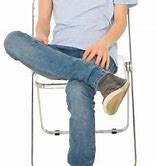
People don't realize, you can actually hurt your knee by 'doing nothing'. Constant pressure on a body part when it is not moving can lead to Isometric Strain Injury. If you are inactive for an extended period of time, and your knee is being held in a position where part of it is being squeezed too much and too long, you may be hurting yourself. This kind of injury happens when you keep your knee locked in a certain position for a long period of time. It may be locked straight, or bent, or maybe with a twist.
If you keep your knee pressed into any one position for an extended period of time, that tissue being squeezed can get damaged. You may damage the Patellar Tendon directly, or you may damage the built-in protectors you have that keep it safe. These protectors are called Bursae or Bursas (Bursa for just one of them).
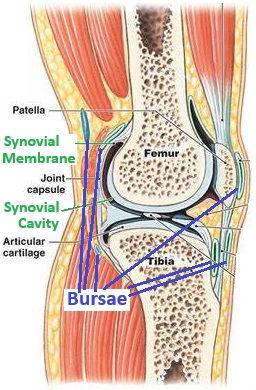
There are many Bursae in your knee. You actually have bursae all over the body keeping everything moving about as it should. All through your body, where there is tissue like a tendon that regularly moves back and forth and could rub on other tissue or bone, your body adds protectors around the area - the bursae. A bursa is a fluid filled sac that acts like a little cushion between tissues in the knee. The bursa creates fluid called synovial fluid with the consistency of raw egg white, that keeps the cushion full. The synovial fluid is also a super slippery substance that seeps very out of the busa to keep the surface of all the tissues lubricated. This allows all the tissue in the area to slide easily past one another, preventing injury.
In the case of isometric strain, if you keep enough pressure in one place for long enough, the synovial fluid gets squeezed out of the bursa until there's no protective pillow left between the different tissues.
Then, if you move suddenly, maybe not even with a lot of effort, a tear is much more likely because your tendon, without the pillow keeping it off of the bone, can get caught on the bone.
Isometric Strain happens more often than you realize.
It's what happens to people who stand in one place for a long time with one or both knees 'locked'.
Or think about crossing your legs for a long time when sitting - that torque on your knee is severe.
Some people cross their ankles when they sleep, hyperextending the top knee and squeezing the knee cap.
Doing so causes the knee of the top leg to hyper-extend for hours possibly, constantly pressing on one part of the knee joint.
There are things that we do, that maybe you haven't thought about that cause isometric strain in different parts of your body.
If you are unsure what caused your injury, think about this possibility as well.
If this is the culprit, then you may need to correct that habit, or you risk causing the injury over and over again.
You will need to stop it for some time to let your knee heal.

If you have Patellar Tendonitis, you should start treating it right away. It should be treated early on, while it is in the acute phase if possible. During this time, you have some damage to the tendon that can be healed quickly. The longer it goes untreated the more likely that a chronic condition will develop. A chronic condition can become degenerative and lead to tendon rupture. Don't delay.
Sometimes it is a sudden change in activity that leads to injury.
If you suddenly change activity levels, your body does not have an opportunity to make adaptive changes to your muscles or tendons, and injury can result.
If you don't regularly exercise, and then one random weekend you play an intense sport, you might stress a muscle or a tendon to a level it just is not adapted to handle.
Tendons do not grow in size and strength the same way muscles do, but they do remodel.
Tendons are made of collagen fibers.
Collagen is a type of protein the body uses to make tendons and ligaments in the body.
When you regularly increase activity - not just once in a while - the body will make more collagen fibers in the tendon to adapt.
Like adding more strands to a cable making it stronger.
For strengthening tendons, doing the activity often - not doing it as hard as possible - is the key.
This is different than growing muscles, which respond well to pushing them close to their maximum level for short durations.
The more often and longer you do a modest activity, the more your tendons increase their ability to handle the task.
Regardless of the activity, the tendons involved will adapt slowly over time.
This adaptation becomes noticeable in the first few weeks and then progresses for 3-6 months.
When the activity is stopped, the tendons will slowly reduce the adaptation.
Just like muscles, they will atrophy and become weaker over time when not used.
If you reduce the intensity of a regular activity, but keep the same frequency, your muscles will atrophy more and faster than your tendons.
If you reduce the frequency of a regular activity, but still keep the intensity high, your tendons will atrophy faster than your muscles.
Injury can happen when you ask the tendons to do too much again, too fast.
Especially after a period where the tendons have adapted to less activity.
This is why professional athletes often get injuries right after returning from the off-season.
They have not been working at the same activity level for months.
They go to the gym and work out intensely, but much less often than when they are doing their sports too.
They see that this keeps up their muscle strength fairly well, but they don't realize the lack of frequency is contributing to more tendon atrophy.
Then at the start of the season they go at it again.
Their memory and skills on how to perform at a high level are still there.
But often their tendons, aren't at that level of strength anymore.
So, when they try to do what they could before, their tendons are not ready for that level of exertion, and they get injured.
This happens to the average person all the time as well.
They suddenly ask their body to go to a level it is not adapted to handle, and injury occurs.
It could be by one day doing a sports activity they haven't done in a while.
Or it could be from any period of relative rest to a level of activity they have not experienced in a while.

Often people increase volume and intensity of their activity at the same time.
They do this with sports for example.
They discover pickleball and quickly change to playing all the time, and going all out.
Or they take up a fitness regimen, and they take the idea of "no pain, no gain" a bit too literal.
Whatever the reason, gradual increases in activity give the body a chance to adapt and avoid injury.
Once you have an injury, if you don't let it rest, it can continue to get worse.
A tear can get bigger.
Or you can get more micro-tears adding up and producing tendonitis like Jumper's Knee.
The more you let it develop, the more the ongoing irritation leads to more inflammation.
It starts to snowball until you have a loop of injury and swelling.
The good news is, with the right steps, you can heal Patellar Injuries for good.
The first step is rest.
Stop doing things that add to the problem - at least until you have the injury under control.
This does not just mean sports.
Stop doing any strenuous activity for a bit.
If you have a bad case of Patellar Tendonitis, it's easy to irritate it and keep it going with even modest movement.
So, do as much resting as you can for a little while.
Reduce activities that require you to move around a lot.
You might need a modified lifestyle for a few weeks.
You will need to be careful of Isometric Strain.
Just rest alone will go a long way toward healing.
Most people don't want to accept how long it can take for an injury to heal.
If you have a stubborn injury or just don't want to wait the time to heal naturally, there are proactive treatments to speed up the healing.
But in reality, rest is a requirement to healing.
Rest at least until your condition stabilizes.
For more information on Proactive Treatments, you can click this link.
There are 3 Key Factors:
1. The severity of your injury.
2. The amount of reinjury you do.
3. Proactive treatments you apply.
What people really want to know is, "When will the pain be gone and I can return to normal life?".
That's very different than when your tissue is actually fully healed.
Long before your Patellar Tendonitis is fully healed, you will be doing most of what you could do before.
If it's very minor Jumper's Knee, then most of the pain can be gone in a few weeks.
But be careful.
Going right back to the same thing that caused the injury can land you right back where you were.
Ease your way back to normal activities.
If it's moderate Patellar Tendon Tear, or persistent Tendonitis, then it can take 1 to 2 months to heal.
It can be a bit tricky because an irritated and inflamed tendon is easy to reinjure.
You have to reduce the inflammation and rest your knee.
If you are going back to sports then wait until you are fully healed and then go back gradually.
Going right back to a full day on the basketball court is a great way to reinjure yourself all over again.
Ease back into activities.
For very bad torn Patellar Tendon, with lots of swelling and inflammation it can take 3 months or more months to fully heal.
You can still reduce the pain and inflammation quickly with cold compression therapy but it will take longer to get back to normal activity.
More damage in the tendon means it will take longer to heal.
At this point, people want to know what they can do to speed up the process.
There are definitely things you can do to proactively speed the healing process.
You don't have to do them but athletes and those who want to shorten the healing time as much as possible will use diathermic processes like BFST.
It will heal on its own, even without those proactive steps.
It will just take longer.

The short-list of things to avoid are to not drive through the pain, avoid using painkillers, and avoid exercising and stretching that can make the situation worse. As long as you are still in the painful stage, exercise is bad, not good. Physiotherapy is also for after you get past the painful period - it's good then, but it can be damaging if started too soon. If you aren't happy with the best-case healing times, don't do things that are going to drag out the injury and use proactive treatments.
There are things you can do to speed up your healing.
Stabilize the injured area and protect from Reinjury with KB Support Tape™.
Use ColdCure® to reduce pain.
Use BFST® to bring blood flow to the area and speed healing.
ColdCure® will take the pain right out of the injured area.
And it will do it without dangerous pain killers and without masking the pain.
KB Support Tape will help protect the injured tissues.
It reduces how much the skin under the tape can move.
This in turn will limit the movement of the damaged tissues below the skin.
It works remarkably well.
Use only high quality medical grade tape.
Not athletic tape.
BFST will help the injured tissue heal by bringing blood flow right where it is needed most.
This way you can get all the benefit of increased blood flow to bring healing nutrients to the injured are without resorting to therapies that can be damaging like exercise or stretching.
For more in-depth information about how injured tissue heals click here for our Healing Page.
For more information on Proactive Treatments, you can click this link.
There is so much bad advice out there when it comes to Patellar Tendonitis. Many common recommendations that you see on the web will not help. In fact, some will make you worse and set your healing back considerably.

There are a ton of bands, braces, and straps on Amazon and other sites claiming to fix Patellar Tendonitis. The idea is that by holding the pressure on the injured tissue it will be protected from moving too much. They also claim it will keep the area from swelling by squeezing the area.
In reality, knee compression bands just make Patellar Tendonitis worse.
You have an injured tendon that is swollen and irritated.
Then you put on a band that tightly squeezes this exact painful spot.
Now you are pressing this injured tendon harder into the bursa underneath it so it will become inflamed as well.
This will add to the pain, irritate the tendon even more, and make it swell more.
Compression bands are the worst advice for Patellar Tendonitis.
Instead, use cold compression to reduce pain and inflammation.
The mild and even compression, combined with cold, will dramatically lower pain levels and inflammation quickly.
Then, use tape to protect your knee from further injury.
Tape provides just the right amount of restriction of movement in the damaged tissues.
Tape does not wrap all the way around the knee, causing excessive restriction and binding of the damaged tissues like a compression band does.
Just run a strip of tape right over the painful area.
Make a "T" with the tape right where the pain is and you will be amazed at how much more stable the area feels immediately.
Run one strip of tape left to right over the pain area.
And another strip straight up the Patellar tendon.
You will marvel at how much this stabilizes the tendon and helps you avoid further injury.
Some people prefer to do an 'X' with both pieces on the diagonal.
Pick whichever method you feel most support from.
Your injury is unique.
Exercising too soon is another mistake. You need to let the tendon rest at first.
If you exercise while the tending is very irritated and inflamed you can set back your healing.
But many sites will suggest exercise.
Stretching will not help.
Tendons don't really stretch so while it probably won't hurt, stretching will not get to the root of the problem to heal your tendon.
There are so many Myths when it comes to healing your Patellar Tendonitis. Injections, TENS, pain meds, and more.
For more information about things to avoid click here for our Patellar Tendonitis Myths page.

Physiotherapists and doctors recommend stretching and strengthening exercises because it helps to promote blood flow through your injured Patellar Tendon.
When we are injured, we need to reduce our activity, and that leads to a weakening of the muscles called atrophy.
In the early days of recovery, it is only the motion that we need to pump the joint.
We don't need to bear a lot of weight on the knee.
Really, as long as you don't feel pain, whatever activity you are doing is probably okay.
So, in the early days of recovering, the early days of PT, the key is motion, not exercise.
Physiotherapy is also intended to help strengthen the surrounding muscles to rebuild that lost muscle once you are on the mend.
But it can be harmful if heavy stretching and exercises are started too early.
Your injury first needs to stabilize, and in order to stabilize the injury you need to rest.
If you still have significant injury, any physio you do should start off very light.
Our advice is, don't start Physical Therapy until your condition has stabilized.
When you start, if you feel pain during or after PT, speak up!
Your clinician can't feel what you feel, so it is very important to advocate for yourself during physio.
Let them know how it feels at each stage so they can use that as a guide to treat you properly.
PT is not supposed to hurt and if it does you may be re-injuring your Patellar Tendon.
Never drive through the pain.
If your physio recommends you work through the pain you should consider a different therapist.
When you rest, your blood flow slows down which doesn't help your injury heal.
This is why BFST® is so important to start early on in your recovery.
The BFST® will increase blood flow when you can't exercise and stretch aggressively.
This enables exchange of nutrients and waste with the synovial fluid - to promote the healing process.
So, with BFST, you can have increased circulation for hours even though your actual motion of your joint is quite light and that is invaluable to your knee.
BFST stimulation also helps prevent reinjury when you become more active.
Giving your Patellar Tendonitis BFST therapy before any activity triggers the tendon as though there is significant exercise going on.
Think of it as a warm-up lap for your knee before you actually start the exercise.
That warm-up is invaluable in preventing reinjury, particularly if you were fairly immobile before hand.
Start BFST early. The earlier the better!
Use the BFST® to warm up your knee before PT and before any other heavy activity.
This will help prevent further injury as a result of the PT activity.
At the beginning of your injury, even before the injury has had a chance to stabilize and long before you start physio, the ColdCure® Wraps will help keep the pain and swelling under control.
Cold compression is highly recommended to stabilize a fresh injury.
And when you are active, invariably, you're going to aggravate your condition to some degree.
If you're very active, you may aggravate it a lot!
After any activity where you may have aggravated your injury, use cold compression to minimize the negative impact and stabilize your Patellar Tendon.
Always use your ColdCure® wrap after any heavy activity and after PT.
The KB Support Tape™ should be applied every morning and worn all day long to help prevent re-injury, including to PT.
It protects you when you move.
KB Tape is armor for your injury.
For many people, King Brand® products, used in the comfort of your own home, are all that is required without having to attend and pay for Physical Therapy appointments.
Because you don't have to move to use them, the King Brand BFST® and ColdCure® Wraps can be started any time in your recovery process.
For more information on Proactive Treatments, you can click this link.
For a little while - not forever - it is really helpful to give your Patellar Tendon a rest. In many cases, resting your knee for a few weeks will give it time to heal to a point that your body gets ahead of the healing / reinjury cycle. It's important to realize that once the pain and any swelling go away, your underlying injury will not be healed completely, so take it easy. Go back to regular life gradually, once the pain and swelling are gone.
For more in-depth information about how an injury heals click here for our Healing Page.


